
Board of Supervisors clarifies injunctions
When San Bernardino County appointed a supervisor, the Supreme Court had to step in.
After the 2018 resignation of Supervisor James Ramos, who was elected to serve in the state legislature, the Board of Supervisors nominated their top applicant picks for interviews by email.
The Board limited the 48 applicants to 13 interviews through their nomination process, and selected Dawn Rowe out of the 13 interviewees to be appointed as Supervisor.
Michael Gomez Daly sued with his civic organization Inland Empire United, claiming the nomination violated the Brown Act, which requires bodies to hold open meetings.
The Superior Court, through Judge Janet Frangie, found the process was in violation of the Brown Act, and Rowe’s appointment was deemed null.
The court ordered Rowe’s appointment be rescinded, and gave appointment power for the position to the governor.
The Board and Rowe appealed, and in a joint petition for review asked if San Bernardino Superior’s court order should have been stayed during the appeal.
The California Supreme Court found Aug. 9 that the order should have been automatically stayed on appeal, because it changed the status quo instead of maintaining it. It required affirmative acts, like the appointment of the governor’s selection, which will change the position of the parties.
Affirmative injunctions are automatically stayed, while prohibitory injunctions take effect immediately, while the injunctions are being appealed, the court said.
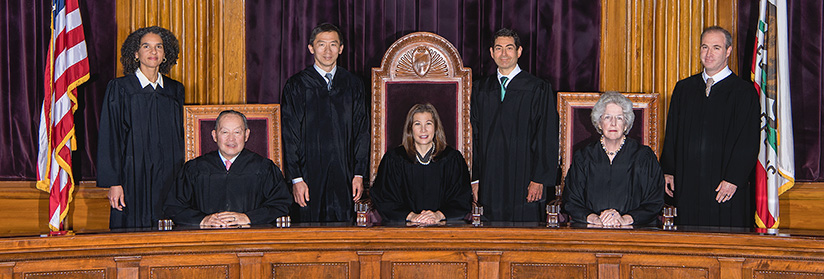
Justice Leondra Kruger authored the opinion of the Court, in which Chief Justice Tani Cantil-Sakauye and Justices Carol Corrigan, Goodwin Liu, Mariano-Florentino Cuéllar, Joshua Groban, and Martin Jenkins concurred.
Supreme Court number S260209.
Appellate case number E073730.
San Bernardino Superior Court number CIVDS1833846.
Read the ruling here.

Death sentence affirmed
The Supreme Court affirmed the death sentence against Run Peter Chhoun, who was convicted of killing all members of a family except for a 3-year-old in a 1995 gang-related San Bernardino home invasion.
Prosecution linked Chhoun to two previous home invasions, in Sacramento and Spokane, Washington, and two fatal drive-by shootings.
Chhoun appealed, contending that the prior murders and his gang membership were irrelevant evidence the court should not have admitted.
He claimed it violated Evidence Code Sections 1101 and 352, which prohibit admission of evidence of a person’s character, especially if it is in regard to uncharged misconduct.
The Supreme Court ruled the prosecution only illustrated the murders to show Chhoun’s regular intent to kill, and not to show he was a bad person.
Court-limiting instructions directed the jury not to use the crimes as evidence of bad character, according to the ruling.
The evidence of gang membership violated no law, the court ruled.
Justice Carol Corrigan authored the opinion, which Chief Justice Tani Cantil-Sakauye and Justices Goodwin Liu, Mariano-Florentino Cuéllar, Leondra Kruger, Joshua Groban, and Associate Appellate Justice Dorothy Kim joined.
Supreme Court number S084996.
San Bernardino Superior Court number FSB08658.
Read the ruling here.
Deported man not informed of plea impacts
The California Supreme Court ruled May 3 that an immigrant deported after he pleaded guilty to stealing a decongestant from a grocery was not adequately informed of the immigration consequences of his plea deal.
Robert Vivar, who came to the United States at the age of 6 and has lived in the county for four decades, pleaded guilty in 2002 after his theft in Riverside Superior Court to violating the Health and Safety Code Section 11383, which triggered mandatory deportation.
If he had pleaded guilty to Penal Code Section 459, he would not have been deported.
Vivar had not been properly advised by counsel, and Vivar’s conviction should be vacated under the prejudicial error clause of California Penal Code 1473.7, the Supreme Court found.
Corrigan concurred in part, but argued in dissent that the majority opinion adopted a form of review that dispenses with the deference normally given to a trial court’s factual findings.
Justice Mariano-Florentino Cuéllar authored the opinion of the Court, in which Justices Goodwin Liu, Leondra Kruger, Joshua Groban, and Martin Jenkins concurred. Justice Carol Corrigan filed a concurring and dissenting opinion, in which Chief Justice Tani Cantil-Sakauye concurred.
Supreme Court number S260270.
Appellate case number E070926.
Riverside Superior Court number RIF101988.
Read the ruling here.

Phone recording law affirmed for privacy
An April 1 California Supreme Court ruling from a Riverside County Superior Court case clarified California’s phone recording law, and overturned a contrary appellate decision.
The case emerged from a call LoanMe, Inc. recorded in conversation between a representative and plaintiff Jeremiah Smith.
A beep indicated the call was recorded, but the LoanMe representative did not expressly inform Smith that the call was being recorded.
Smith brought suit against LoanMe, and a bifurcated bench trial decided that the beep gave Smith adequate notice that the call was being recorded.
The Fourth Appellate District had ruled that Penal Code Section 632.7 prohibited third parties from recording phone calls without permission, but did not prohibit members of the call from recording without the permission of the other.
The Supreme Court overruled the lower courts and found that no one can record phone calls without the consent of the other party.
The law makes it a crime when someone “without the consent of all parties to a communication, intercepts or receives and intentionally records, or assists in the interception or reception and intentional recordation of, a communication transmitted between” specific types of telephones.
Committee analysis of the bill, which became the law, combined with the text of the law, convinced the Supreme Court.
Chief Justice Tani Cantil-Sakauye authored the opinion of the Court, in which Justices Carol Corrigan, Goodwin Liu, Mariano-Florentino Cuéllar, Leondra Kruger, Joshua Groban and Martin Jenkins concurred.
Supreme Court number S260391.
Appellate case number E069752.
Riverside Superior Court number RIC1612501.
Read the ruling here.
Death penalty review finds no fault in San Bernardino
In an automatic review of the death penalty against the convicted kidnapper and killer Thomas Battle, the Supreme Court found no error in a San Bernardino Superior Court case and affirmed the conviction.
Battle was convicted of killing the married couple Andrew Demko, 77, and Shirley Demko, 72.
Their bodies were found Nov. 18, 2000, by hunters in the San Bernardino desert.
The San Bernardino District Attorney charged Battle with two counts of murder, one count of first degree residential burglary, one count of first degree residential robbery and two counts of kidnapping in November, 2001.
Justice Mariano-Florentino Cuéllar authored the opinion of the Court, in which Chief Justice Tani Cantil-Sakauye and Justices Carol Corrigan, Leondra Kruger, Joshua Groban, and Martin Jenkins concurred. Justice Goodwin Liu filed a dissenting opinion
Supreme Court number S119296.
San Bernardino Superior Court number FVI012605.
Read the ruling here.