
Plaintiffs alleging infliction of emotional distress do not have to be present at the scene of accidents, the California Court of Appeal ruled April 26.
Instead, plaintiffs could have experienced the accident virtually, through a phone call.
In a dissenting opinion, Judge William Dato said the appellate ruling also adopted a rule that goes against Supreme Court precedent, references improper precedent and unnecessarily burdens plaintiffs.
The ruling bridges the gap between conflicting precedent regarding claims of negligent infliction of emotional distress, said Greg Rizio of Rizio Lipinsky, the plaintiff’s attorney.
The differences in standards comes from different lines of standards between medical malpractice cases and personal injury cases.
Rizio has petitioned the California Supreme Court to weigh in. He agreed with Dato’s dissenting opinion, and said that the established medical malpractice standard should not be applied to regular personal injury cases.
“It is my sincere hope that the Supreme Court considers reviewing this decision and providing more clarity,” Rizio said.
The accident
Plaintiff Malyah Vance was driving her 2006 Kia Spectra eastward on Riverside’s Via Zapata Dec. 4, 2018, according to the complaint. She was on her way to a Realtor’s office, and was on the phone with her mother and co-plaintiff, Jayde Downey, to get directions.
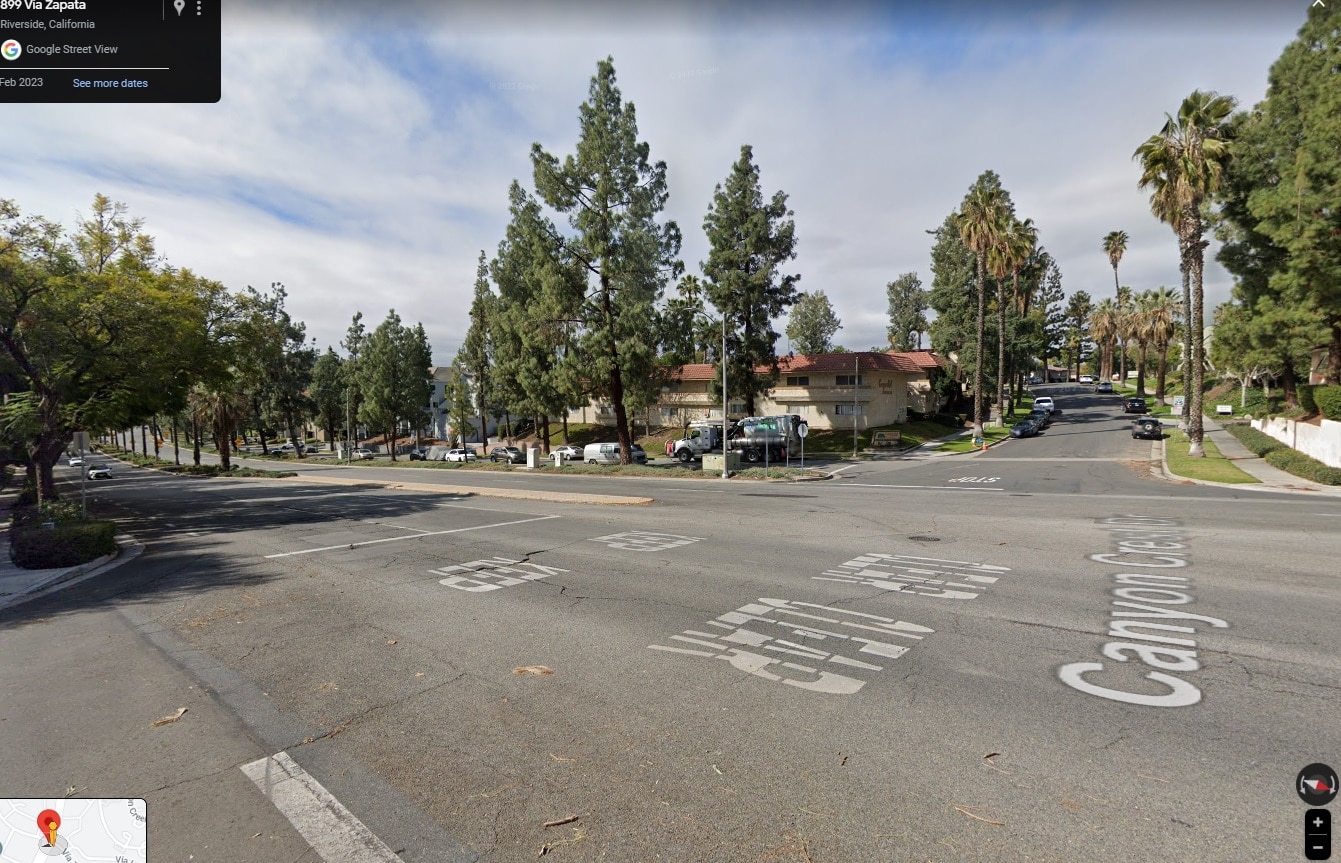
Vance’s navigation system told her she had arrived, but she told Downey that she was driving around an apartment complex, and that she was at an address near to the Via Zapata and Canyon Crest intersection, which is directly north of the Canyon Crest Country Club and the Sycamore Canyon Park.
Downey told her to take a left onto Canyon Crest from Via Zapata. Vance said she was going to go left, in a way that indicated she was counting off traffic until she knew it was safe.
Downey then heard Vance take a sharp breath and say a shocked “Oh,” followed by the sound of shattering glass and skidding tires.
Silence followed, and Downey drove to the scene.
Downey kept speaking into the phone, trying to get a response, until she heard a stranger’s voice say, “Would you stop? I’m trying to find a pulse.”
Vance survived the crash, but suffered a traumatic brain injury that has affected her relationship with her mother, according to Rizio.
The complaint
Vance and Downey’s complaint claims that Riverside city created an unsafe condition of public property by having too high of a speed limit on Canyon Crest Drive, and by omitting traffic markings and signals.
The city knew about multiple collisions in the intersection, but did not correct dangerous conditions, the complaint claimed.
They also claimed that Ara and Vahram Sevacherian, the owners of the property at the corner, created a danger by not trimming vegetation and trees that blocked the view of traffic for people taking a right onto Canyon Crest Drive from Via Zapata.
Their third amended complaint brought causes of dangerous condition of public property against Riverside and separate counts of negligence against the driver of the car, Evan Martin, and the Sevacherians.
Riverside city spokesperson Phil Pitchford declined to comment on the ruling.
Dismissed for lack of standing
Riverside Superior Judge Harold Hopp dismissed the allegations against the Sevacherians and Riverside Sept. 24, 2021, without granting Vance and Downey leave to amend their complaint.
California has three mandatory requirements for a plaintiff to bring a negligence case for which they are bystanders and not injured themselves, according to the appellate ruling.
The plaintiff has to be closely related to the injured person, has to see the injury-producing event at the time it occurs and be then aware it is causing injury and has to suffer emotional distress.
Hopp found that Downey did not meet that second requirement of seeing the crash.
“The allegations are insufficient to show that Downey had a contemporaneous awareness of the injury-producing event— not just the harm Vance suffered, but also the causal connection between defendants’ tortious conduct and the injuries Vance suffered,” Hopp wrote.
Remote bystander grounds
The Court of Appeal said that recent advancements in technology—such as phone calls and livestreaming—allow family members to qualify for the second requirement even if they were not physically at the scene.
The majority ruling cited the 2020 case Ko v. Maxim Healthcare Services, which allowed parents to bring a case after watching a livestream video during which a health care worker abused their son.
“(T)echnology for virtual presence has developed dramatically, such that it is now common for families to experience events as they unfold through the livestreaming of video and audio. Recognition of (negligent infliction of emotional distress) claim where a person uses modern technology to contemporaneously perceive an event causing injury to a close family member is consistent with the Supreme Court’s requirements for (such) liability and the court’s desire to establish a bright-line test for bystander recovery,” the Ko ruling said.
Knowledge of the danger
The majority ruling, however, said it was not clear that Downey knew about the dangerous condition of the intersection. It is possible she knew about the intersection and its danger, but that knowledge was not included in the complaint.
The majority opinion directed Downey to have leave to amend her complaint to include her knowledge of the intersection’s danger.
Dato’s dissenting opinion found that this direction gave too high of a burden to plaintiffs to prove. Downey’s third amended complaint was adequate, he said.
“Nothing requires that (Downey) be aware of each and every separate act of negligence that may have contributed to the accident,” Dato wrote.
He said that the ruling could protect many at-fault defendants from being sued.
“How can someone listening on a phone know what Martin did or did not do? And what if Martin were to claim that a passenger in the car, with whom he was arguing, grabbed the steering wheel, causing the vehicle to veer off course? Is Downey precluded from stating a claim against the passenger because she couldn’t possibly know about the passenger’s involvement? Or if Martin says he couldn’t stop because of faulty brakes repaired by a negligent mechanic? Is the mechanic insulated from a claim by Downey?” Dato continued.
Dato said that the majority opinion’s decision that Downey failed to argue a claim based on lack of knowledge came from a medical malpractice case that should not be applied to a personal injury case. He also said that a California Supreme Court case expressly rejected this kind of argument.
“The court expressly disclaimed any suggestion that a bystander-plaintiff ‘must be aware of the tortious nature of defendant’s actions,’” Dato wrote, quoting the 1985 case Ochoa v. Superior Court.
“‘Such a requirement,’ in the court’s view, ‘would lead to the anomalous result that a mother who viewed her child being struck by a car could not recover because she did not realize that the driver was intoxicated.’” Dato continued.
Rizio, agreeing with Dato, said it did not make sense to limit whom a bystander-plaintiff could sue. If Vance could sue the city, Downey, as a mother who witnessed her daughter’s injury, should also have that ability, Rizio argued.
The majority opinion denied Dato’s argument in a page-long footnote. The note said that a plaintiff must have knowledge that a defendant caused some injury to the plaintiff, not the exact reason for the plaintiff’s action.
“‘Ochoa held only that recovery would be permitted if the plaintiff observes both the defendant’s conduct and the resultant injury, and is aware at that time that the conduct is causing the injury,’” the footnote said, quoting the 1989 case Thing v. La Chusa.
Case information
Riverside Case No. RIC1905830
Appellate Case No. D080377
Greg Rizio and Eric Ryanen of the Rizio Lipinsky Law Firm represented the plaintiffs.
City Attorney Phaedra Norton, Senior Deputy City Attorney Michel Verska and Deputy City Attorney Cecilia Rojas represented Riverside.
Gary Klein and Shelby Kennick of CP Law Group represented the Sevacherians.
Associate Justices Terry B. O’Rourke and Judith McConnell wrote the majority opinion. Justice Will Dato wrote the minority opinion.
Read the complaint here.
Read Hopp’s dismissal here.
Read the appellate ruling here.